The basics of heat and light
Alistair Gamblin, 23/02/2026
The topic of heat and light is one of the most complex and highly debated in reptile care. Every species has a very unique set of needs; all perfectly provided in the wild, but offering exactly the same to our captive animals isn’t always easy. Constant advancement in our knowledge of natural history and science is, however, leading to a huge range of products entering the market to help keepers provide the very best to their animals. In this article I hope to help clear up some common misconceptions, whilst explaining the different types of heating and lighting, and how these can be used to reflect wild habitats.
What is light?
Light is much more complicated than what we as humans can see. Visible light makes up just a tiny portion of the electromagnetic spectrum, and, in fact, some of the most important parts of this spectrum for reptiles are those that we cannot see. The electromagnetic spectrum runs from the long-wave radio waves to the much shorter gamma rays. The spectrum itself has an incredible array of uses in everyday life, but for the purposes of this article, we’ll be focusing on those in the middle: infrared, visible light, and ultraviolet.
Infrared light has the longest wavelength of these three sections of the spectrum, at between 760nm and 1mm, whilst ultraviolet has much shorter waves at just 100-400nm. They are each named because of how they sit alongside the part of the spectrum visible to humans, with infrared longer than red waves, and ultraviolet waves being shorter than those of violet light. All three (infrared, visible, and ultraviolet) are naturally occurring from the same source: the sun. All reptiles, no matter their habitat, or whether nocturnal or diurnal, will experience sunlight, and it is from here they will warm their bodies and expose themselves to essential radiation.

This chart shows the approximate composition of sunlight reaching Earth:
Over half of the sun's output is made up of infrared radiation at 54.3%. These waves are longer than other light types so are able to pass through the atmosphere more easily. The light that we see makes up approximately 38.9% of the output, whilst the smallest portion is that of ultraviolet radiation, at just 6.8%
What does light do, and why do reptiles need it?
Heat and light play vital roles in the lives of animals, helping them to maintain their physical health and behaviours. Reptiles are in a group of animals known as ectotherms. Unlike humans who are able to maintain their own internal body temperature through homeostasis, reptiles and other ectothermic species rely instead on external sources of heat, such as the sun. The sun provides animals with the 3 key wave types listed above, infrared, visible light, and ultraviolet. Each of these has a specific role to play in maintaining the health of an animal, including us.
- Infrared: Invisible to both humans and reptiles, infrared goes visually unnoticed yet makes up the largest portion of the sun’s rays. In fact, there are 3 types of infrared, ranging from the most powerful and deeply-penetrating, IR-A, to the weakest, IR-C. As the wavelengths penetrate the skin and go into the body, the reptile’s core temperature increases. By regulating their exposure to these rays, ectothermic animals are able to control their core body temperature. The sun emits each of the 3 types of infrared radiation to varying levels, with IR-A having the highest output at almost 70%. It is the combination of each of these levels of infrared radiation that is vital for the health of reptiles. Without being able to maintain their body temperature, the animals would not be able to carry out vital bodily functions such as digestion.
- Visible light: The light that we as humans can see is vital in the health of all animals. By providing a clear day/night cycle, it allows species to coordinate their circadian rhythms, or the times at which they are awake during a 24-hour period. Reptile vision is also much better than that of a human (we are trichromatic, whilst many reptiles are tetrachromatic, possessing a 4th cone type), and this allows them to see beyond this section of the electromagnetic spectrum and into the ultraviolet zone, where they can build a much more detailed, colourful perception of the world.
- Ultraviolet: The smallest portion of the sun’s rays is made up of ultraviolet radiation; however, this is just as important to reptiles. As with infrared, UV can be split into 3 sections: UVA, UVB, and UVC. UVA, the closest to the visible light spectrum, and can be seen by reptiles, but not humans. It is used by reptiles much like visible light, playing a role in breeding and activity. UVC is not used by reptiles as it cannot get through the Earth's protective ozone layer. It is UVB that is the most important part of the ultraviolet spectrum. All reptile keepers should have heard of UVB and are more than likely aware of its importance. UVB- in conjunction with heat- is utilised by reptiles to synthesise Vitamin D3, which in turn is used to metabolise calcium from their diet. Without being able to absorb calcium, many reptiles are susceptible to a common condition known as Metabolic Bone Disease (MBD). This irreversible condition has devastating impacts on reptiles, but is easily prevented through appropriate husbandry, including the provision of UVB lighting.
The sun's full spectrum of rays have a variety of important functions to aid reptile health and welfare
This includes aiding vision and acting like a clock, with visible light providing clear day and night cycles. For some species these may change throughout the year, which encourages seasonal behaviour such as breeding. Infrared radiation also allows reptiles to use the sun like a heater, increasing their core body temperature, which- along with UV light wavelengths- aids calcium absorption, preventing MBD

Together, each of these three sections of the electromagnetic spectrum enable reptiles to live a healthy life. They each work in conjunction with one another in a delicate balance, and if even just one section is missing in captivity, serious illness is a very real possibility.
How do I provide heat and light?
As we’ve already discussed, reptiles and other animals will naturally access heat and light from the sun. They’ll achieve this by spending portions of their day basking beneath the sun’s infrared, visible light, and ultraviolet rays. In captivity, we must do our very best to replicate the sunlight in our enclosures. Thankfully, many products now exist and are readily available in exotic pet shops and online. This makes our job much easier! In this section we will look more deeply into how we can provide reptiles with the correct types and quantities of light.
Bulbs can easily be broadly classified into one of 3 categories: heat, light, or both. Below is a table which shows the most used bulb types, and what each is used for. It is important to note that this table does not include consideration of wattage, strength, effectivity, frequency of replacement, or method of control.
| Product | Radiation type | Use |
|---|---|---|
| Deep-heat projector | Infrared (primarily IR-A) | Long-range heating |
| Halogen bulbs | Infrared and visible light | Creating basking spots and aiding vision |
| Ceramic heat emitters (CHE) | Infrared only | Raising ambient enclosure temperatures, and night-time heating |
| Fluorecent UV tubes | Visible light and UV | Enabling Vitamin D3 synthesis |
| Compact UV bulbs | Visible light and UV | Enabling Vitamin D3 synthesis |
| LED | Visible light | Aiding vision and daylight cycles |
| LED/UVB combined bulbs | Visible light and UV | Aiding vision and Vitamin D3 synthesis- relatively new technology still being researched |
| Mercury vapour bulbs | Infrared, visible light and UV | Basking and enabling Vitamin D3 synthesis |
| Metal halide bulbs | Infrared, visible light, UV | Basking and enabling Vitamin D3 synthesis |
| Heat mats | Infrared (primarily IR-C) | Raising ambient temperatures in localised areas |
Looking at the table above, note that there is no single product able to fully meet the full-spectrum needs of any reptiles. Often a combination of 2 or more products is needed to ensure each type of radiation is sufficiently provided (eg. Halogen bulbs for daytime basking, CHE for ambient and night-time heating, LEDs for full-spectrum visible light, and UV tubes for UVA and UVB provision).
Whilst reptiles benefit from heating and lighting, it is important that they have opportunities to control their exposure, just as they would in the wild. Enclosures must feature areas of shade, as well as a gradient in temperature across the space. As reptiles control their core temperature and body systems using external sources, they can then choose which area of the enclosure to place themselves, either increasing their exposure to warm up, or decreasing it to cool down. It is also important that heat and light are provided at a species appropriate level. Some species will only need a basking spot, and are able to thrive at ambient room temperature, whilst others will need to have basking areas and an overall higher ambient temperature. Similarly, species found in different habitats will be exposed to differing levels of UV radiation. Before buying any equipment, it is vital that keepers have a good understanding of the needs of their specific species. It is also important to monitor levels of heat and light within an enclosure. This is especially important in the case of UVB-emitting products, each of which have a working lifespan, and require regular replacement, even if visually no change is noticed.
Do all reptiles need heat and light?
A subject of great debate in the reptile keeping community is the requirement of heat and light for all species. Often this concerns the use of UVB lighting. Whilst UVB is a necessity for many reptile species, some argue that for others it is completely unnecessary. Snakes, for instance, have evolved to absorb the Vitamin D3 from their prey, and as a result have become much less reliant on the sun’s UVB rays for calcium absorption. Similarly, many nocturnal reptile species rarely see the light of day, and some argue they do not require UVB.
On the other hand, many studies have shown that when any reptile species is provided with UVB lighting, it often has positive effects on their health and behaviour. Therefore, there is an argument that all species should be offered a level of exposure to the natural cycles and full spectrum they would experience in the wild. Even nocturnal species, who will seek safety out of direct light during the day, will still naturally be exposed to some level of UVB in a process known as cryptic basking.
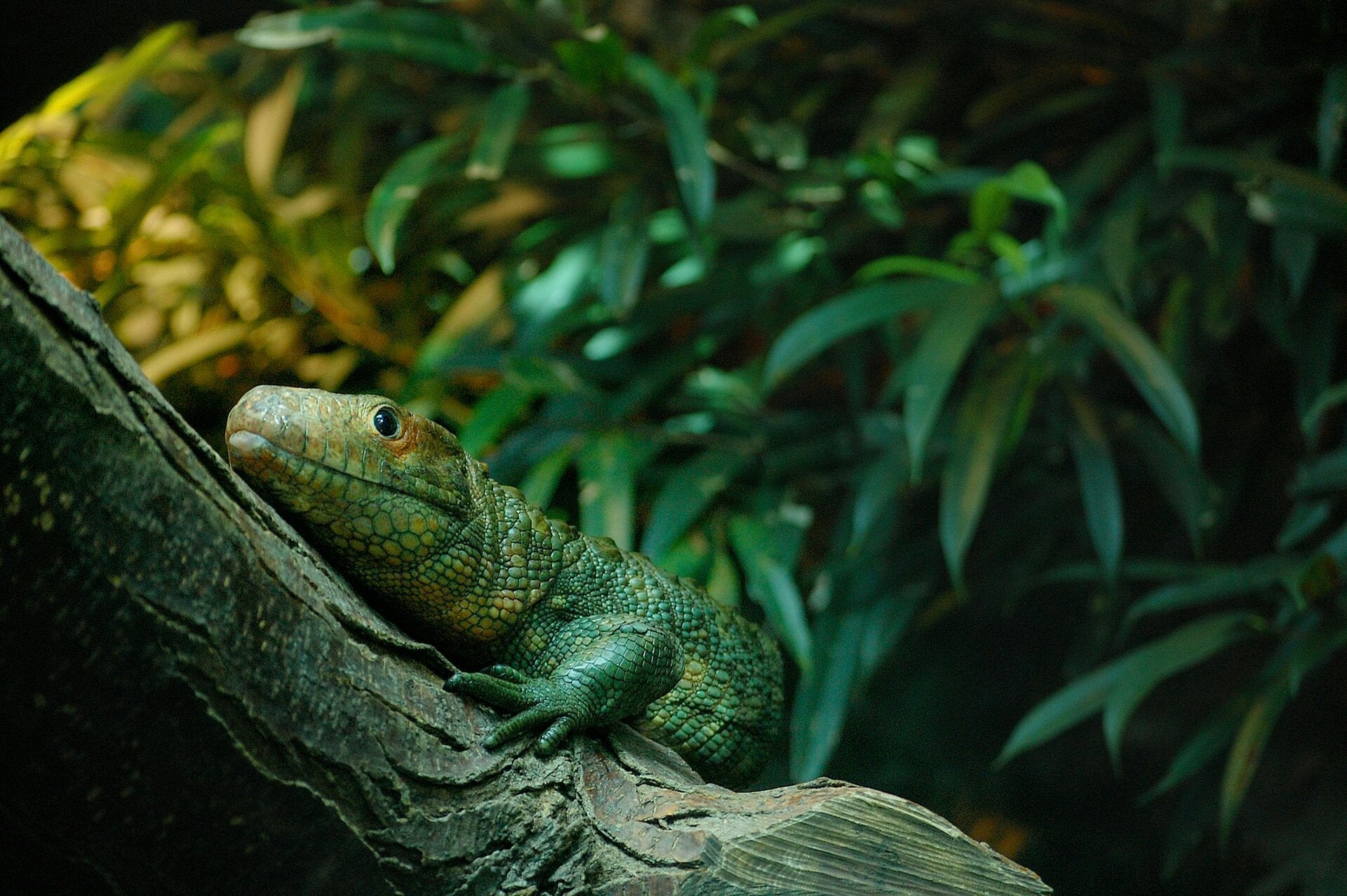
Many nocturnal or shade-dwelling reptiles use 'cryptic basking' to expose themselves to UVB radiation
This enables them to safely keep tucked out of harms way during the day, whilst a small part of their body is exposed to the sunlight, allowing them to absorb the full spectrum of the sun's rays
I am of the personal belief that providing all reptiles with a full spectrum of infrared, visible light, and ultraviolet radiation can only have a positive effect, provided it is suitable for the species, and the animal is given choice and control over its exposure through careful enclosure design. As the topic of lighting continues to be carefully researched by the scientific community, the provision of full spectrum lighting, including UV, is becoming increasingly common not just for reptiles, but also for other taxa, such as invertebrates, mammals, and birds.
In summary...
Heating and lighting remain for many a very confusing topic of husbandry debate, yet I hope that through this article I have been able to simplify the science. Full spectrum lighting, which includes heat, is vitally important to allow reptiles to carry out their typical biological processes. Without appropriate environmental parameters, keepers will almost certainly discover health issues within their reptiles.