Written 2021, updated 10/03/2026
| Species profile: |
|---|
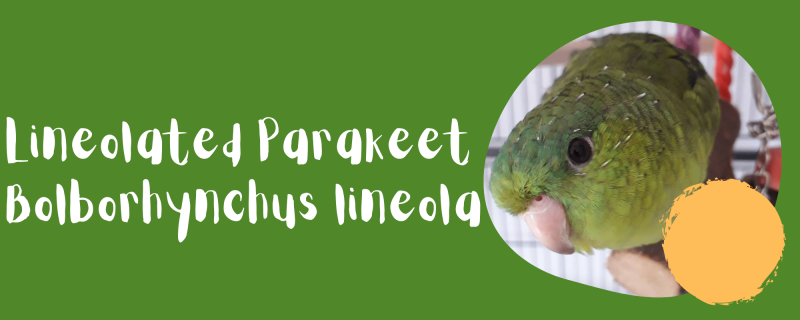
| Species: Lineolated Parakeet/Barred Parakeet |
| Scientific name: Bolborhynchus lineola |
| Range: Latin/Central America |
| Lifespan: 10-15 years in the wild, 20-25 years in captivity with good care |
| Description- The Lineolated or Barred Parakeet is a small Central American parakeet species standing only 6-7 inches tall. They have a dark green body, fading on the front of the body, offering the perfect camouflage in their dense forest homes. Across the back and wings are thick, broken black lines, which help to break up their shape in the canopy. These markings give them their ‘lineolated’ or ‘barred’ name. They have a pale pink hooked beak, ideal for breaking into seeds and fruits. They can be quietly vocal, and are popular in captivity due to their non-destructive and personable nature. |
| Difficulty of care: Medium |
Natural habitat and enclosure design-
The Lineolated Parakeet can be found in Latin America’s highland forests. They have a wide distribution across much of Central America, living in the mountainous regions through from Mexico to Panama. They are known to opt for certain areas of their habitat throughout the year, following the most favourable weather and feeding conditions up and down the mountains. They are hardy birds, and deal with a huge range of weathers and temperatures.
When it comes to housing birds in the home, there are several main options. These include indoor cages/aviaries, outdoor aviaries, or bird rooms. Below is a brief overview of the advantages and disadvantages of each housing method.
- Cages: keeping birds in a conventional cage is without doubt the most common method used by owners. They’re effective, practical options, and generally much cheaper than alternatives, but are not without their drawbacks. Even the largest of commercially-available bird cages provide very limited space for natural behaviours, especially for more active and intelligent species such as parakeets and parrots. It can also be incredibly difficult to provide an enriching or naturalistic environment in a cage setting. In addition, whilst cages offer an ideal space for sleeping and eating, most species- including the Lineolated Parakeet- should have plenty of time outside of their cages each day, in a bird-safe room. When I have housed birds in cages before, I have ensured the cage itself is larger than the minimum requirements for the species, and left the cage doors open for much of the day to provide choice and control for my birds.
- Indoor aviaries: indoor aviaries can be purchased commercially (often at a high cost) or built yourself with relative ease. They offer more space and enrichment value than a typical bird cage, and eliminate the risk of predation/pests which may come from an outdoor setup. An indoor aviary could allow a much more natural environment to be created, utilising natural perching and plants. One consideration with commercially made indoor aviaries is their bar spacing. Most are constructed with larger species in mind, and these can have a larger bar spacing, therefore reducing the security of the enclosure for a small species, and posing a greater risk of injury (e.g. trapping a body part).
- Outdoor aviaries: an outdoor space is always my preferred option for my own birds. This may not always be a suitable housing option and will often depend upon your specific circumstances, such as the species, location, weather, and more. They are by far the most costly option, but can offer a much larger and naturally designed space than others when well planned and constructed. This also allows more birds to be housed, which can be beneficial for species which would naturally occur in social groups.
- Bird rooms: perhaps the least common method, reserved only for the most dedicated of bird keepers, is the bird room. For those lucky enough to have a spare room in their houses, they can be converted simply into a perfect enclosure for birds. They can offer much more space than standard cages and have many of the advantages of an outdoor aviary in a more controlled environment. This could be a good option for a keeper looking to provide the space of an outdoor aviary but concerned about predators, vermin, and poor weather.
For the sake of the remainder of this section, we will look at the requirements of caged Lineolated Parakeets, as this is the most common method of housing. If you can provide larger environments- indoors or out- I would encourage you to do so. Otherwise, let’s continue...
Lineolated Parakeets may be small, but they are an energetic species and require plenty of space and environmental enrichment. Most keepers will suggest a cage no smaller than a 60 centimetre (24 inch) cube. Again, bigger is always better, and I would suggest keepers find the largest cage they can fit into their available space. Whilst height is beneficial- and many birds will feel most secure at greater heights- the width of an enclosure is more important. Birds fly side to side, not up and down, so a tall thin cage is not at all suitable. All cages should have a bar spacing of no more than ½ inch, as this will ensure the bird cannot injure itself. When purchasing a cage, ensure you pay close attention to these dimensions, and avoid models which have other larger gaps which could cause injury.
In most of my care guides I focus on providing naturalistic conditions for the animal, but this can be quite difficult in a cage-type setup. Despite this, there are ways we can still provide opportunities for natural behaviours, it may just not quite look like a Latin American forest!
Perching is one of the most important furnishings for a bird enclosure. In most cases, cages will come with perching. I would recommend setting this to one side and instead collecting or purchasing your own perch materials. Birds will spend the majority of their time on their feet, and inappropriate perching (such as the smooth dowels or plastic tubes included with most bird cages) can be detrimental to their foot health, causing sores and infections. I combine a variety of perch materials and diameters in my bird enclosures, many of which are bird-safe branches collected from outside and disinfected for biosecurity. The natural variety of textures and diameters is great for foot and claw maintenance. Other perch options include rope (care should be taken to ensure there is no risk of entanglement) and flat platform perches, usually constructed from wood. If you are offering plenty of time outside of the cage, the cage itself can be designed more as a ‘playroom’, densely packed with perching and toys.
Toys are available in a wide variety of materials, textures, and colours, and each toy is often designed with a specific behaviour in mind. A variety of types should be included in the enclosure and rotated regularly to reduce boredom. As you get more used to your individual birds, you will be able to purchase more of the toy types your bird will enjoy. Lineolated Parakeets are not typically destructive, so this should be considered when choosing products.
Additional equipment can be placed around the room for when your bird spends time outside of its cage. Take care to ensure your bird remains safe when out of the enclosure. Lineolated Parakeets have a habit of burrowing between blankets, pillows, and other soft furnishings in the home. Keep an eye on your bird’s location, and check behind you before taking a seat!
Environmental conditions-
In an indoor environment, there is no need for supplementary heating or lighting, provided the cage can be situated in a draught-free, well-lit area, out of direct sunlight. Whilst individual bird’s needs will vary, the Lineolated Parakeet is generally a social species with other birds of its kind, and people. As a result, it is likely they will thrive in a high traffic area of the home, such as a main living space. Just be mindful of the common threats to birds around the home, which can be found here.
Some keepers will offer birds housed indoors supplementary UV lighting due to its importance in synthesising Vitamin D, just like in humans. This is still a relatively new husbandry development and being heavily researched for various taxonomy. Studies suggest exposure is important, however it should be carefully controlled to prevent health issues, much like in mammals.
If housing your birds outdoors, a draught-free indoor sheltered area will be required. To maintain an ideal temperature, a heater may be required dependent upon temperatures and weather conditions in your area. This being, said this species is highly adaptable, experiencing a wide range of temperatures throughout the year. Some reports even suggest they occasionally experience snow in the high-altitude areas of their wild range.
Diet and feeding-
A large part of a wild bird’s day will be spent foraging and feeding. Therefore, it is important that their daily allowance of food and water is available constantly throughout the day.
Contrary to popular belief, the diet of a captive bird should be varied, including a range of fresh and formulated foods. An all-seed diet is not suitable and can be detrimental to an animal’s overall health with its high fat content. This species would naturally feed from a variety of sources, such as fruits, seeds, sprouts, and insect larvae in the wild. The bulk of a captive Lineolated Parakeet’s diet should be made up of commercial pellet diets (which can be considered a complete diet) and fresh foods. Most keepers will recommend a diet of:
- Pellet: this is a vital part of the diet which includes all the nutrients, vitamins and minerals needed by your birds. They come in a range of sizes, shapes, textures and flavours. Your bird will likely develop a preference over time but may also require a bit of encouragement to get them eating pellet diets in the first place. It should make up around 60% of the diet.
- Seed: to prevent issues such as selective feeding and obesity it is important that seeds make up only a small portion of the overall diet. A high-quality seed mix is important for the health of your bird, and high-fat mixes should be avoided. Sunflower seeds can be offered in moderation, and would be a great high-reward feed item for training sessions. Overall, a seed mix should make up no more than 10-15% of the daily intake.
- Fresh food: a wide range of safe fruits and vegetables can be offered to your birds. Birds may show a preference for fruits due to their high sugar content, but variety is important. Although Lineolated Parakeets will consume fruit in the wild, the fruit available in most supermarkets is filled with much more sugar and does not offer a suitable alternative to wild fruits. In fact, most supermarket vegetables are more like wild diets, and several zoological collections have reduced or removed fruit from the diets of their fruit-eating species. To save time and reduce waste, large batches of fresh food can be prepared in advance and frozen for later use. Just thaw all frozen food in the fridge overnight. Fresh foods should make up the remaining 30% of the diet.
Provided with the diet above, additional supplementation is not necessarily required, however products such as Nutrabol, Vionate, and Avimix are available and can be included in line with the guidance on the packaging.
To reduce predictability, you can change how and where you offer food. This may also help to reduce selective feeding, where animals show a strong preference to certain feed types and do not get the full variety of feed they require. You could move food bowls to different areas of the cage or create several feeding stations for you bird to visit throughout the day. You can also increase feeding time by using dietary enrichment methods, which will be covered more in the next section.
It is suggested that food and water should be offered in stainless steel bowls. These are easiest to clean, do not harbour bacteria, and will survive the occasional nibble. Fresh food and water should be replaced daily, and when soiled.
Some guides and keepers may recommend the use of grit to help with digestion. This is not at all necessary and can have more harmful impacts than positive uses. For the long-term health and safety of your birds, please do not offer grit as part of the diet.
Wild behaviour and enrichment-
The Lineolated Parakeet is a social species, and will naturally live in flocks of several individuals. Keepers should consider whether they wish to house their bird alone or with others of their species. I am of the opinion that wherever possible social species should be housed in pairs or groups to best meet their phycological needs. If you intend to house more than one bird, consider that larger housing will be required. Additionally, take care to avoid accidental breeding and ensure you have a suitable sex ratio, whilst carefully monitoring behaviour.
Birds are intelligent animals and require plenty of enrichment to keep their minds active and bodies healthy. Whilst we have already made several suggestions to keep your birds busy, there many more simple ways we can offer our birds to opportunity to carry out their natural behaviours.
Adding things to the bird’s environment is the simplest way of keeping them stimulated. This could include new toys, perching, feeding areas, or anything else. Similarly, regularly swapping the placement of items, or removing certain features for a short period entirely can be a great way of reducing boredom and encouraging natural exploratory behaviours. I have also included natural foliage into my bird enclosures, which provides new sights and smells, as well as opportunities to climb and chew. Ensure the browse offered is from a non-toxic plant and free from disease risk.
Dietary enrichment is also an important part of husbandry, and is a great way of increasing the time taken for your bird to eat to more natural durations. Novel or high-reward feeds could be offered on occasion for variety. This could include items such as sprouts, larger seeds, and nuts. It can also be more interesting for your birds if the standard diet is varied, for example using different fresh feed items throughout the week. Food can also be presented in different ways, such as chopped, roughly chopped, or left whole. Smaller fruits and vegetables could even be speared on perching to promote natural feeding and foraging around the cage. Puzzle feeders can also be utilised to stimulate your bird’s brain. There are many options available to buy, but you could also make your own very simply, using readily available materials like cardboard, and minimal equipment.
Lineolated Parakeets are well-known for enjoying bathing. Some will appreciate a shallow bowl of water in their cage, large enough for their bodies, whilst others prefer a ‘shower’ from a gentle mist. If using a spray bottle ensure you allow your bird choice and control over the situation and let them move into the path of the mist rather than spraying them directly.
Birds are also built to fly, and flight is vital for staying healthy. Some keepers will practise controversial wing clipping or pinioning on their birds. I do not believe that this is an acceptable method of care as it takes away the bird’s biggest freedom. Whilst there may be some cases where a medical concern deems temporary restriction in movement and flight, it is my opinion that it cannot be justified long-term.
Health and disease prevention-
As with any pet, these birds can be susceptible to several different illnesses, including mites, worms, bacterial infections and more. Indoor-housed birds are less-likely to contract certain health issues, however husbandry-related issues such as egg binding are just as likely in either case. Birds require very specialist care and many standard domestic veterinary practices will not be able to provide for the specific needs of avian patients. As a result it is important to register your bird with an approved avian vet. Veterinary care can be very expensive, so ensure you have the means to cover any unexpected costs, or consider insuring your pet.
- Mites- there are numerous mites that can affect birds such as Air Sac Mites and Scaly Face/Foot mites. These are often simple to cure using easily obtained treatments, although it is best to consult your avian vet, especially in advanced circumstances. Unfortunately, scaly face mites is something we have had to deal with in our aviary, although happily the issue was quickly spotted and controlled. Quarantining new birds and using preventative mite treatment will ensure safety of any birds already in your home.
- Plucking and self-mutilation- when birds over groom themselves or each other, it is often a sign that something is wrong. Whilst it can indicate a health problem or skin issue, it is most commonly associated with stress or boredom, and considered a stereotypical behaviour. Providing an enriching environment will reduce the likelihood of these issues.
- Egg binding- this is where females are unable to pass eggs, often due to poor diets and lack of essential vitamins/minerals. If immediate vet treatment is not provided, it is likely to be fatal, as they often cannot pass the eggs on their own. A proper diet, including as much variety as possible, will reduce the chances of this occurring.
- Bacterial infections- there are numerous bacteria that can cause illness, and far too many to list here. Consult your vet immediately if you see any signs of a bacterial infection, which includes nasal discharge and watery eyes, along with other symptoms. Regularly cleaning enclosures and their environment, along with setting up new birds in quarantine, will minimise risk of such infections.
- Viruses- viruses in pet birds are often highly contagious. For example, Avian Flu is dangerous in wild birds, and if not properly protected during an outbreak, aviary birds can easily pick it up, and your entire flock would have to be culled to prevent further spread. Some viruses are treatable with veterinary care, so contact your vet at the first signs of a virus for diagnosis and treatment.